 listicle
MC Electrical Contracting Alternative for Renovations
Table of Contents
- What to Look for in an Electrical Contracting Alternative for Renovations
- How to Vet Electrical Contractors Before Your Renovation
- Hiring an Electrician Who Shows Up on Time
- Questions to Ask Electrical Contractors Before Hiring
- Comparing Electrical Contracting Alternatives: Services, Pricing, and Fit
- Why BEARS Electric Is a Strong Alternative for Renovation Projects
- Frequently Asked Questions
Last Updated: September 10, 2026
What to Look for in an Electrical Contracting Alternative for Renovations
An electrical contracting alternative for renovations is a licensed electrical contractor you bring in when your current provider is unavailable, overbooked, or not the right fit for a remodel involving panel work, new circuits, and inspection sign-off. Renovation electrical work fails more often from poor planning than poor wiring, and choosing the wrong contractor is the most expensive planning mistake a homeowner can make.
A kitchen remodel that adds a range hood, dishwasher, and six recessed lights can push a 100-amp service past its limit (peer-reviewed research). That is why the contractor you pick matters more than the fixtures you pick.
Below, we break down the vetting criteria, the questions that separate professionals from pretenders, and how to compare alternatives on scope, pricing structure, and fit.
Licensing, Insurance, and Code Compliance
Every electrical contractor working in a home must hold a valid state license, carry liability insurance, and pull permits for the work (portal.ct.gov). In Connecticut, electrical work falls under the scope of the Connecticut State Electrical Work Licensing Board, which sets licensing and code enforcement requirements.
Ask for the license number and verify it directly with the state, not just on the contractor's website. Then request a certificate of insurance showing both general liability and workers' compensation coverage. If a helper gets hurt in your basement and the contractor has no workers' comp, that claim can land on your homeowner's policy.
Code compliance is not optional during a renovation. New circuits, panel changes, and added outlets must meet current code and pass inspection. A contractor who suggests skipping the permit to save time is telling you exactly how they operate.
Renovation Experience and Project Scope
Remodel electrical work is a different discipline from service calls. A contractor who is excellent at replacing a faulty outlet may have little experience sequencing rough-in wiring around framers, drywallers, and cabinet installers.
Ask how many full renovations the company has completed in the last two years and whether it has handled panel upgrades alongside new circuit runs. Whole-project capability matters: if your renovation needs a service panel upgrade, dedicated circuits, and smart home wiring, you want one contractor managing all of it rather than three trades blaming each other when the inspection fails.
How to Vet Electrical Contractors Before Your Renovation
Vetting an electrical contractor means verifying credentials, checking references from similar projects, and reading the estimate closely before you sign. What most guides skip is the renovation-specific layer: the permit record, the rough-in schedule, and the inspection sequence that determine whether your remodel stays on track.
Checking Credentials and References
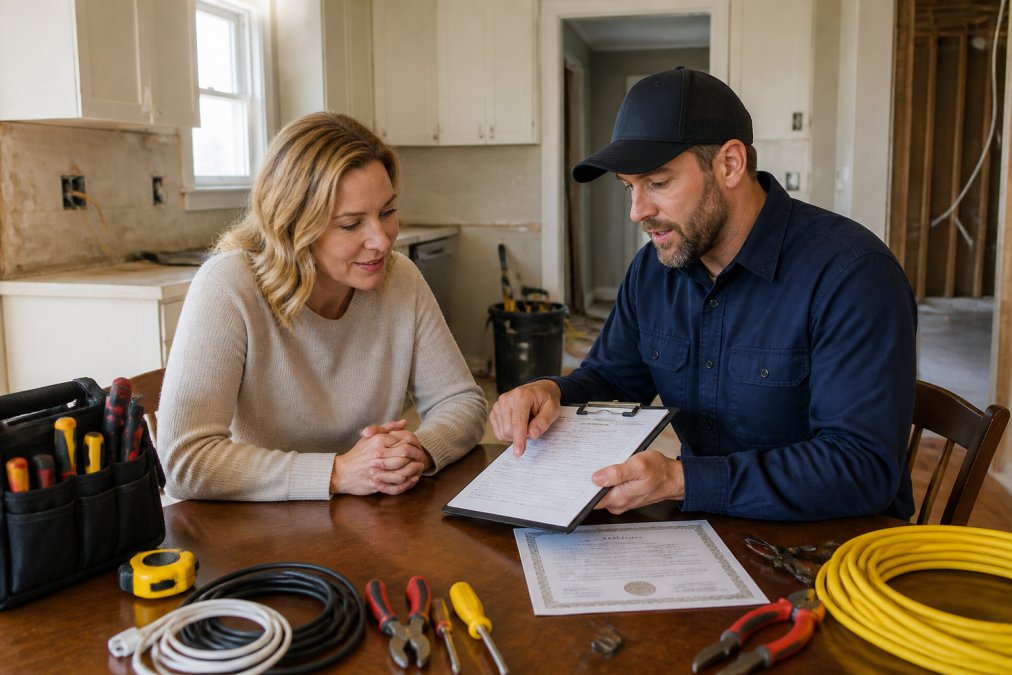
Start with the license lookup, then move to references. Ask for two or three recent renovation clients, not just service-call customers, and call them. A common mistake is asking "were you happy?" instead of "what went wrong and how did they handle it?" Every project has friction, and how a contractor responds tells you more than a five-star review.
Verify that the company carries general liability insurance and workers' compensation, and confirm the policy is current. Then check whether past projects required permits and whether those permits were closed out with a passing inspection.
The Permit and Inspection Trail
This step separates a renovation electrician from a service-call electrician. Ask the contractor to walk you through how a typical remodel permit flows from application to final sign-off. One who has done this repeatedly will describe it without hesitation:
- Permit application, filed with the local building department before any wiring is touched, listing the scope (panel change, new circuits, device count).
- Rough-in inspection, scheduled after framing and wiring are complete but before drywall goes up. This is the inspection that catches code issues while they are still cheap to fix.
- Cover inspection, some jurisdictions require a second look after insulation and before closing walls.
- Final inspection, after devices, fixtures, and the panel are energized and labeled.
Ask which of these steps your project will trigger. If they cannot answer, they have not pulled many renovation permits, a common pattern is discovering mid-project that the rough-in was never inspected, forcing the drywall down to expose the wiring.
Red Flags That Signal Trouble
Certain behaviors should end the conversation immediately:
- No license number, or a number that does not match state records
- Pressure to skip permits or start work before a written estimate
- A quote given over the phone without anyone walking the space
- Requests for full payment upfront or cash-only terms
- No physical business address or verifiable local history
- Vague answers about who will actually perform the work
- Inability to describe the inspection sequence for your project
The One-Hour Vetting Checklist
Block an hour and work through this in order.
- License lookup, verify the number against the state licensing board's public record, not the contractor's website.
- Insurance certificate, request it directly and confirm the policy dates cover your project window.
- Permit history, ask for two permit numbers from recent renovation jobs and confirm they were closed with a passing inspection.
- References, call two renovation clients and one service-call client. The renovation clients will tell you about scheduling and coordination; the service client will tell you about responsiveness.
- Estimate review, confirm the estimate lists the panel, circuits, devices, permit fees, and inspection scheduling as separate line items.
- Schedule commitment, get the rough-in window in writing, along with who your point of contact will be.
If any item on this list cannot be produced, that is your answer. Move to the next contractor.
Hiring an Electrician Who Shows Up on Time
Reliability is the most common complaint homeowners raise about electrical contractors, and the hardest quality to verify in advance. Test it by watching how the company handles first contact.
Did they answer the phone or return the call the same day? Did they arrive for the estimate within the promised window? A company that is late and uncommunicative before you have paid them will not improve after you have.
Ask directly what happens if the crew is delayed, and get a scheduling commitment in writing. For renovation timelines, ask how the contractor coordinates with your general contractor and other trades, because an electrician who misses the rough-in window can stall the entire project.
Questions to Ask Electrical Contractors Before Hiring
The right questions surface scope gaps, hidden costs, and capability limits before work begins. Bring this list to every estimate:
- What is your state license number, and who is the licensed master electrician of record?
- Will you pull the electrical permit, and who schedules the inspection?
- Does your estimate include the panel upgrade, or is that a separate line item?
- How do you calculate the electrical load for the new circuits?
- What is your payment schedule, and what triggers each payment?
- Who is my point of contact during the project, and how do I reach them?
- What warranty do you offer on workmanship, and how long does it last?
- How do you handle change orders if we add scope mid-project?
A contractor who answers these clearly and in writing is a contractor worth considering. One who deflects or promises to "figure it out later" is not.
Comparing Electrical Contracting Alternatives: Services, Pricing, and Fit
Comparing alternatives comes down to three variables: scope capability, pricing structure, and project fit. A contractor perfect for a single-room refresh may be wrong for a whole-house rewire. The gap most guides leave open is the renovation timeline, electrical work has to slot into a sequence of framers, drywallers, and cabinet installers, and the contractor you pick has to hit those windows.
What Drives the Cost of a Renovation Electrical Project
Electrical renovation pricing depends on the scope of work, the condition of the existing system, and whether the service panel needs replacement. Older homes with outdated systems often require a panel upgrade before new circuits can be added safely.
Cost drivers to expect in any estimate:
- Panel upgrade or replacement and the associated load calculation
- New circuit runs, including wiring repair where old cable is found
- Fixture and device installation, including smart home wiring
- Permit fees and inspection scheduling
- Repair or replacement of any failed components found during rough-in
Because BEARS Electric does not publish fixed pricing, the honest answer is that cost depends on scope. Get a written, itemized estimate and ask what is excluded. Compare two estimates line by line, not by the bottom number, a lower total that omits the permit fee or panel upgrade is not a lower price, it is an incomplete scope. Get a free quote to understand the specific pricing for your project.
How Electrical Work Fits the Renovation Timeline
Electrical work in a renovation is not a single visit, it is at least three, and each has to land in a specific window:
- Pre-construction walkthrough, before demo, the electrician maps existing circuits, identifies what can be reused, and flags whether the panel has capacity for the new load.
- Rough-in, after framing and before drywall. New cable runs, box placement, and panel work happen here. The rough-in inspection follows.
- Trim-out, after drywall, paint, and cabinets. Devices, fixtures, and the panel get energized and labeled. The final inspection follows.
If the electrician misses the rough-in window, the drywall crew either waits (costing schedule) or closes the walls (costing a tear-out later). Ask every contractor you compare how they coordinate with a general contractor and how far in advance they schedule the rough-in. One who cannot describe this sequence has not run many renovations.
Matching the Contractor to Your Project Type
Different projects call for different contractor profiles. Use this table as a starting filter:
| Project Type | What to Prioritize | Watch Out For |
|---|---|---|
| Single-room refresh | Availability and clean finish work | Contractors who only do large jobs |
| Kitchen or bath remodel | Circuit planning and code compliance | Estimates that ignore load limits |
| Panel upgrade with rewiring | Licensed master electrician on staff | Crews that skip the permit |
| Whole-home renovation | Project management and trade coordination | No experience with general contractors |
| Generator or EV charger add-on | Load calculation and dedicated circuits | Contractors unfamiliar with modern loads |
A Bid Comparison Framework
When two estimates land on your table, score them on the same five axes so the decision is not driven by the bottom line alone:
- Scope completeness, does the estimate name the panel, the circuit count, the device count, the permit, and the inspection scheduling?
- Schedule fit, can the contractor commit to your rough-in and trim-out windows in writing?
- Coordination, do they have a named point of contact and a history of working with general contractors?
- Inspection record, can they show closed permits from recent renovation jobs?
- Warranty, what is covered on workmanship, and for how long?
A contractor who scores well on scope but cannot commit to a schedule is a renovation risk; one who scores well on schedule but leaves the panel out of the estimate is a budget risk. The right alternative scores acceptably on all five.
Why BEARS Electric Is a Strong Alternative for Renovation Projects
BEARS Electric is a minority-owned electrical contractor serving Bristol and the surrounding Central Connecticut area, in business since 2012 with over 12 years of industry experience. For renovations, that experience covers the full scope: panel upgrades, complex wiring repair, generator and EV charger installation, and the inspection coordination that keeps a remodel on schedule.
What sets BEARS Electric apart is how it handles the two things homeowners worry about most: transparent pricing with no hidden fees, so the estimate reflects the work performed, and a commitment to strive for same-day service when a renovation uncovers a problem that stalls the project.
Customer feedback reflects both. John B. noted that the team "exceeded them with their efficiency, professionalism, and friendly guidance." Frank L. described a faulty wiring issue solved quickly after a fast response. Every project carries a satisfaction guarantee.
If you are comparing electrical contracting alternatives for a renovation in Bristol, Terryville, Plainville, Unionville, Burlington, Wolcott, Plymouth, New Britain, or anywhere within the surrounding area, BEARS Electric handles the whole project rather than handing you off to multiple contractors.
Frequently Asked Questions
What should I look for when hiring an electrician for a home renovation?
Start with a valid Connecticut electrical license, proof of insurance, and a track record on renovation projects. Ask whether the contractor handles permits and inspections, and request references from similar jobs. A written scope of work with a clear schedule matters too. For a renovation, the electrician should be comfortable coordinating with other trades, planning circuits for new layouts, and upgrading service panels when the existing load cannot support the new work.
How can I tell if an electrical contractor is reliable and punctual?
Look for a contractor who confirms appointments in writing, provides a realistic arrival window, and communicates proactively if anything changes. Ask past customers directly about timeliness. A company that offers same-day service and has a local reputation for showing up is a safer bet than one that only promises it. You can also ask how they handle scheduling conflicts and whether they assign a dedicated project manager for renovations.
How do I verify an electrical contractor's license in Connecticut?
Connecticut requires electrical contractors to hold a license issued by the state. You can verify a contractor's credentials through the Connecticut Department of Consumer Protection's online lookup. Ask for the license number and confirm it matches the name on the contract. Also request a certificate of insurance for general liability and workers' compensation. A legitimate contractor will provide these without hesitation and will be fully insured before starting any work.
What are the benefits of choosing a minority-owned electrical business?
A minority-owned electrical business often brings a strong commitment to community relationships and customer service. Many are locally based and invested in their reputation within the neighborhoods they serve. They may also offer more flexible scheduling and personalized attention than larger firms. When evaluating any contractor, focus on licensing, insurance, experience, and verified reviews, while recognizing that a minority-owned firm can deliver the same quality and professionalism.
Why is it important to hire a local electrical contractor for renovations?
A local contractor knows the area's permitting office, inspection timelines, and common housing stock, which speeds up the renovation process. They can respond faster to site visits and warranty calls. For homeowners in Central Connecticut, working with a contractor based in the region means easier coordination with other local trades and quicker access to materials. Local contractors also have a reputation to protect in the community, which encourages reliable work.
Renovation electrical work rewards careful contractor selection and punishes shortcuts. Verify the license, confirm the insurance, ask the hard questions, and insist on permits and inspections for every circuit. If you want a contractor who shows up on time, prices the work transparently, and manages the full scope from panel upgrade to final inspection, BEARS Electric is ready to help. Get a free quote and put your renovation electrical work in experienced hands.